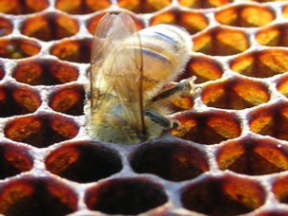
Trap 7–8 bees minimum. You'll release one bee per bearing reading (3 per point × 2 points = 6), plus a couple spares in case one doesn't fly straight home.
Use a bee box with bait. A few drops of anise oil, lemongrass oil, or wintergreen oil works well — or use old dark honeycomb soaked in sugar syrup. Avoid plain commercial honey (disease risk).
Let bees feed until calm. A fed bee flies straight home; a startled one won't give a reliable bearing.
Release ONE bee at a time. Watch closely as it circles briefly then takes off — that's its beeline home.
Hold your phone flat and level — like a tabletop compass, screen facing up. Point the top edge of the phone in the same direction the bee flew, then tap "Bee flew off."
Repeat 3 times per point for a reliable averaged bearing before locking it in.
Stay away from metal — mailboxes, cars, fences, and metal posts throw off phone compasses badly. Take readings in open ground at least 10–15 feet from anything metal.
Calibrate your compass first — wave your phone in a slow figure-8 motion a few times before starting. Most phones do this automatically but it helps accuracy.
Walk as far as you reasonably can between Point A and B — even 20m works, but 40m+ gives noticeably tighter results since short baselines amplify small compass errors.
Find bees foraging on flowers nearby, then feed and capture a few in a bee box.
N
— °
Follow the gold arrow
📱 Hold phone flat & level, like a tabletop compass
📡 GPS: waiting for signal...
Release a bee, point phone where it flew, then tap:
🚶 Walked: 0 m from Point A (20m+ ok · 40m+ better)
— m
to candidate hive site
Point your phone forward to start
🐝
Most of the wild bee colonies we've found haven't been checked on in years.
We've logged 1,150+ feral hives since 2008 — but almost none have been confirmed still active since. You can check on one near you in under a minute. No experience needed.
All Modules
Module 1 of 92 min
🐝 Log a Hive
🧭 Pre-filled from Pathfinder triangulation — confidence radius ~—m. Review before saving.
📍 Where
📍 Coordinates pre-filled from the map crosshair. To change location: close this form, pan the map to your hive, then tap Add again — or use GPS below.
🐝 What kind of hive?
🌳Live Tree
🪵Dead Tree
🍯Beehive
🏠Structure
🌿Ground
📝 Details
📍 This location will be publicly visible on the SaveTheHives map.
📋 Hive Records
Not signed in
Needed to log a hive, check in on one, or vote on ideas — a one-time email link, no password.
Invite someone to the whole project — sends a link to the app with a short pitch about what SaveTheHives does.
Looking to share one hive instead?
That's a separate button — open any pin on the map and tap Share This Hive. It sends a link straight to that exact pin instead of the general app.
← About
Install app
← About
Pin legend
Live Tree — Active feral colony in living wood
Dead Tree — Colony in snag or fallen timber
Beehive — Managed langstroth/top-bar box
Structure — Colony in a wall, building, or other structure
Ground — Subterranean or ground-level nest
← About
Ideas & voting
Loading ideas…
Sign in to vote.
← About
How to contribute
🐝 Log a hive — Tap Add, center the map crosshair on the hive, fill in what you know, and submit. Sign-in required to prevent spam.
✅ Check in on existing hives — Tap any pin, then tap Share This Hive to send yourself the coordinates for directions. Once you're there, look up and around for bees, then tap Check In to report whether it's still active, gone, or uncertain. Every check-in helps track colony survival over time. Tap Check In in the bottom menu to jump straight to hives near you that need it.
📍 Legacy records — The 1,100+ records from 2008–2017 haven't been checked in on since they were first logged. If you're near one, please check in.
← About
Mission & research
SaveTheHives is a citizen science platform mapping feral honeybee colonies across North America —
1,152 legacy hive records from 2008–2017 and growing.
Each 3-mile "Mating Radius" overlay visualizes drone flight potential and genetic corridors; feral bees
that survive 3+ winters without treatment are what this project calls Genetic Goldmines —
valuable breeding stock for disease-resistant bee populations. Check-ins are how survival gets tracked today; automatic badges are coming soon.
Data is crowdsourced, and accuracy improves the more a hive gets checked in on. Legacy records span 2008–2017; accuracy varies. New submissions are timestamped and linked to the observer's account.
Researchers interested in data access or collaboration: [email protected]
Scientific framing reviewed and approved by Dr. David Tarpy, NC State University Scholar Professor & Extension Apiculturist.